
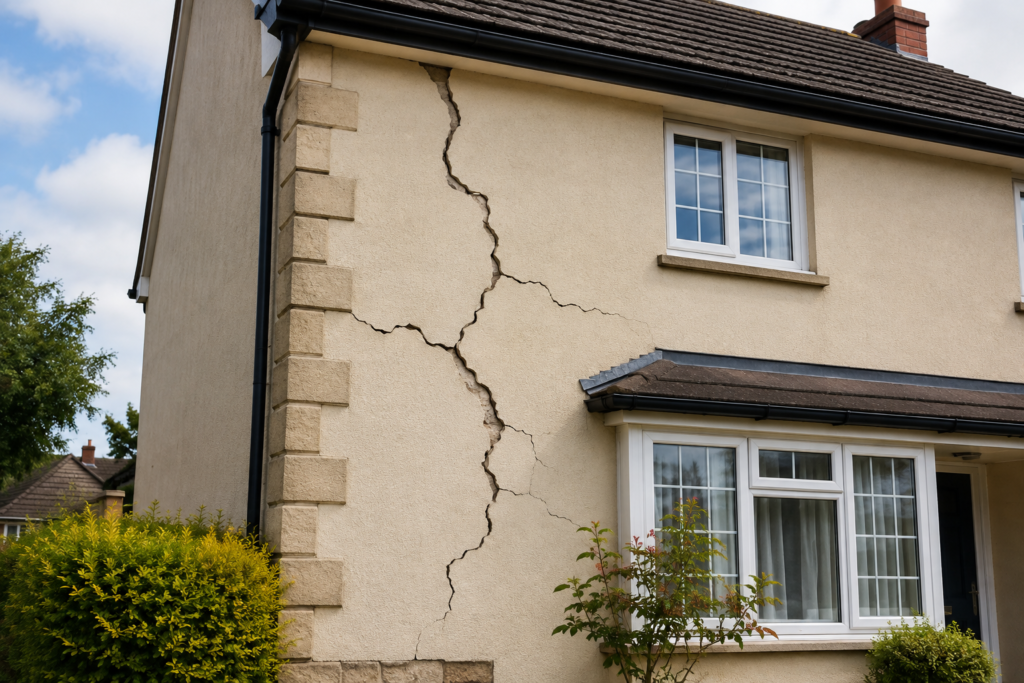
A Cracked House
by David Buchanan
Short Answer – From 2035 the Decent Homes Standard applies to private rented sector and BTL properties in England under the Renters’ Rights Act 2025. Landlords must meet five criteria: free of Category 1 HHSRS hazards; reasonable state of repair; core facilities (including external noise insulation); thermal comfort linked to MEES; and free of damp and mould. Repair costs can exceed available equity in some cases. Include it in any report on title when buying a BTL or considering renting. There is no blanket “costs exceed value” get-out for the full standard.
The Renters’ Rights Act 2025 finally brings the Decent Homes Standard (DHS) into the private rented sector. Full enforcement for BTL and PRS landlords begins in 2035. This is not a distant theoretical risk. Category 1 hazards are already enforceable today. Minimum Energy Efficiency Standards (MEES) demand EPC C by October 2030. Conveyancers, buyers of investment property and tenants need to understand the five criteria now so they can price the risk correctly.
Why the Decent Homes Standard 2035 matters for BTL conveyancing
When you buy a BTL, the report on title and due diligence must flag future compliance costs. A property that looks fine under current rules may need significant works by 2035. Tenants and local authorities will have stronger tools. Non-compliance risks improvement notices, civil penalties (up to £7,000 for certain breaches) and, in serious cases, restrictions on letting. Equity-thin portfolios or older stock in noisy or poorly insulated locations face the greatest pressure.
The five criteria of the new Decent Homes Standard
1. Criterion A – Free of Category 1 hazards (HHSRS)
The property must be free of the most serious health and safety hazards under the Housing Health and Safety Rating System. Category 1 means a high likelihood of harm requiring medical attention within 12 months. Excess cold, severe damp, falls, fire risks, electrical faults and structural collapse all feature. Local authorities already have a duty to act and can issue on-the-spot fines. This criterion is live now; 2035 simply embeds it inside the wider DHS.
2. Criterion B – Reasonable state of repair
A home fails if any key building component is in serious disrepair or if two or more other components need major work. Key components include roofs, walls, windows, doors, heating systems, electrics, kitchens and bathrooms. The old age-based kitchen and bathroom replacement rules have been dropped. Condition, not age, is the test. Mechanical ventilation and lifts (where present) are also covered. This is the criterion that most often drives unexpected capital expenditure for BTL owners.
3. Criterion C – Core facilities and services (including noise insulation)
Flats must provide at least three of: adequate kitchen space and layout; appropriately located bathroom and WC; adequate external noise insulation; and adequate common entrance areas. Houses need at least two of the first three.
Noise insulation is the element many landlords overlook. Where external airborne noise (road, rail, aircraft or industrial) is a problem, the landlord must provide reasonable insulation, typically acoustic glazing meeting current Building Regulations. Triple glazing is a frequent practical solution in high-noise locations. The requirement is location-specific; internal noise between flats is not covered under this criterion. Child-resistant window restrictors on fall-risk windows are also mandatory.
4. Criterion D – Thermal comfort and MEES
The primary heating system must heat the whole home and be controllable by the tenant. The property must also meet Minimum Energy Efficiency Standards. For the PRS this means EPC C (fabric-first under the reformed metrics) by 1 October 2030, subject to a £10,000 cost cap and the usual MEES exemptions. Energy work done for MEES counts towards overall decency but does not automatically satisfy the other four criteria.
5. Criterion E – Free of damp and mould
This is a new standalone criterion. Landlords must remedy damp and mould and take proactive steps to prevent it. An HHSRS assessment scoring bands A–H fails the test (only minimal issues in bands I–J are excluded). This sits alongside the planned extension of Awaab’s Law principles into the private sector and forces earlier intervention than Category 1 alone.
Costs, equity and the absence of a blanket financial exemption
There is no general “repair costs exceed the value of the house or the equity” exemption that excuses full DHS non-compliance. Confirmed exemptions are narrower: tenant refusal of access, physical or planning constraints (for example listed buildings), and the specific MEES cost-cap and related energy exemptions.
In practice, older properties, those in high-noise areas requiring triple glazing, or stock needing structural and thermal upgrades can generate bills that wipe out thin equity. Impact assessments show significant aggregate costs across the PRS, with a long tail of higher-cost properties. Responsible landlords who keep properties in good order will face lower bills; those who have deferred maintenance face a steeper climb to 2035. For conveyancers this means the valuation and survey must be read against the five criteria, not just current marketability.
Practical steps for BTL buyers, owners and tenants
- Instruct a surveyor who understands the new DHS criteria, especially noise, damp and key-component condition.
- Ask your conveyancer to include a specific note in the report on title about Decent Homes Standard 2035 compliance risks and any known exemptions.
- Budget now for MEES 2030 works; they form part of Criterion D.
- Keep records of repairs, EPCs, access attempts and any registered exemptions.
- Tenants should report damp, mould and hazards promptly; landlords who ignore them face both existing enforcement and the future DHS regime.
The government has given a long runway precisely so landlords can plan. Waiting until 2034 is not a strategy. Properties that already meet or are close to the five criteria will be more attractive to buyers and lenders; those that do not will trade at a discount reflecting the works required.
Related reading on Conveyancing Limited
The Renters’ Rights Act 2025 – Your 3 Step Guide to changes coming in 2026
Essential MEES Regulations 2026 Guide
Licence Or Lease? Renters Rights Act 2025 Trap For Landlords
This is an educational website. The law is developing and secondary legislation plus detailed guidance will follow. Always take formal advice on your specific property through an SRA-regulated firm before acting. If you are buying, selling or refinancing a BTL and need the Decent Homes Standard 2035 risks examined in the report on title, get in touch.