
Short Answer – A breakdown of how to calculate freeholder compensation on a lease extension value . Landlord compensation is the deceased value to the landlord plus half of the increased value to the tenant.
Click here to see why marriage value is set to be abolished, eventually.
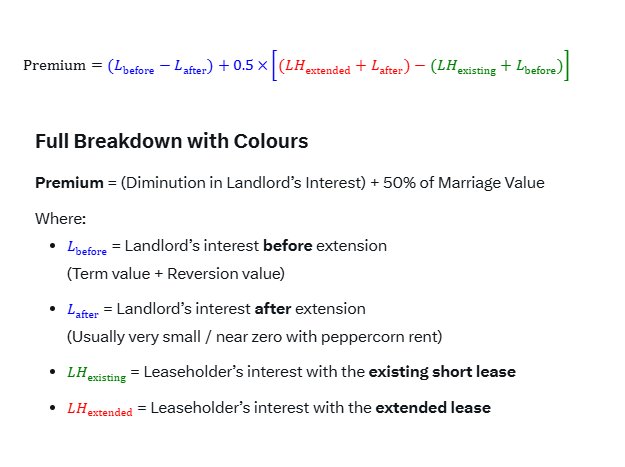
It’s the green and red which is on its way out….
A simplified example of how you can calculate Landlord Compensation and marriage value i.e. the amount the Landlord can ask from the Tenant to extend his lease.
In example, I’ll show how the new reforms reduce the compensation payable to the landlord by 74% – remember it’s just a simple example, not real world. In the ‘real world’ this would be done with software and databases with insured expert surveyors who prepare compliant reports, possibly CPR compliant – but, this is how the maths works – fundamentally, this is what’s going on under the surface
Contents
Warning! This mage contains maths. It is illustrative only. The calculation by a surveyor would be more detailed, and the surveyor’s role would be to say what the values of each variable are.
At the end, I’ve added calculation methods for the blue variation – the freehold values.
This is just to give you an idea of how it’s done. To prepare a section 42 notice to extend your lease you need a qualified surveyor to work out the values and the calculation. It is not recommended that you do it yourself, but it interesting to see the process.
Bare Bones Equation for Landlord Compensation (with Marriage Value)
This is the Core Formula from Leasehold Reform, Housing and Urban Development Act 1993 – Schedule 13 – link here > (Current Law – 1993 Act, Schedule 13)
Expanded Form of the equation – this is the equation from the image above again.
Where:
- = Landlord’s interest before extension
(Term value + Reversion value) - = Landlord’s interest after extension
(Usually very small / near zero with peppercorn rent) - = Leaseholder’s interest with the existing short lease
- = Leaseholder’s interest with the extended lease
Notes on the Bare Bones Equation
- Applies only if the unexpired term is 80 years or less.
- Above 80 years → Marriage Value = 0.
- The equation ignores intermediate leases, rent reviews, development value, and minor adjustments for simplicity.
- All values are as at the valuation date (usually Section 42 notice date – the notice the Tenant gives to start the statutory lease extension process).
- Term = Capitalised ground rent. – see the note below!
- Reversion = Deferred freehold / long lease value.
This is the stripped-down logic used in statutory lease extension valuations.
Step by Step Calculation – Landlord Compensation and Marriage value
- Flat with 70 years unexpired lease
- Freehold vacant possession value evidence supports the following valuations:
| Variable | Amount – which the surveyor tells you | Colour |
|---|---|---|
| £6,000 | Blue | |
| £100 | Blue | |
| £230,000 | Green | |
| £270,000 | Red |
Step 1: Calculate Landlord’s Loss (Blue)
This is the full diminution in the landlord’s interest (Term + Reversion). The tenant always pays 100% of this.
Step 2: Calculate Combined Value AFTER extension (Red)
Step 3: Calculate Combined Value BEFORE extension (Green)
Step 4: Calculate Marriage Value
This £34,100 is the total “marriage value” created by extending the lease.
Final Result Total Premium payable to the Landlord in our example is £22,950. The maths is quite easy.
Conclusion – loss of 74% of compensation payable to the landlord
The landlords gets paid for his loss to his freehold, plus half of the benefit of the tenant i.e the 50% shares of increased value of the lease – the green and red part.. The Green and Red are the tenant’s gain or ‘marriage value’.
Taking out the marriage value in this case would reduce the cost to the Tenant by £17,050 at the landlord’s expense . This is why there is a question as to whether these proposal comply with the Human Rights Act – Arc Freeholders may be a point – is it actually fair to do this, or is it so unfair that the government intends to break the HRA or ECHR?
Other notes – it gets more difficult however.
What does “Term = Capitalised ground rent” mean?
The Term Value is the present-day lump sum that represents the total future ground rent the landlord would have received for the rest of the existing lease. Instead of receiving small annual ground rent payments for the next 60–80 years, the landlord is compensated with one upfront payment. This is done by “capitalising” (converting) the future income stream into a current value.
How It Works
- Ground Rent = The annual amount the leaseholder pays the landlord (e.g. £150 per year).
- Remaining Term = How many years are left on the current lease (e.g. 70 years).
- Capitalisation Rate = The yield/interest rate used to discount those future payments (typically 5%–8%, depending on the rent level and location — often agreed or decided by Tribunal). Those of you familiar with discount cash flows in share valuation will pick this up quickly.
Basic Formula for Term Value:
(With adjustments if the ground rent changes over time or for the exact number of years remaining.)
Example
- Annual ground rent: £200
- Capitalisation rate: 6% (0.06)
This £3,333 is added to the Reversion Value to make up the landlord’s total interest before the lease extension ( in the colour-coded equation).
Why This Matters
- After a statutory lease extension, the new lease is at peppercorn rent (essentially £0).
- The landlord loses the future ground rent income → the tenant must compensate the landlord for this loss via the Term Value.
- This is one part of the Blue component in the equation:
Note: In practice, valuers often use more precise Years Purchase (YP) tables or financial calculators to account for the exact number of years and any rent reviews, but the core idea is always the same: turning future rent into today’s money.
What “Reversion = Deferred freehold / long lease value” means
Reversion is the landlord’s right to get the property back at the end of the lease. If he own a freehold, the tenant leaves when the lease ends and the landlord gets back an empty unit. Because they don’t get it back for many years (e.g. 65 or 75 years), you cannot give them the full current value of the flat. Instead, you calculate what that future value is worth today — this is called the deferred value. In plain English:
The reversion is the present-day price of the landlord’s future right to own the flat again when the current lease expires. i.e. it’s a possession claim.
Simple Breakdown
- Freehold = What the entire flat would be worth if it was owned outright today (e.g. £300,000).
- Deferred = Discounted because the landlord must wait decades to get it.
So Reversion Value = Today’s full value of the flat × Discount for waiting X years
Example
- Current freehold value of the flat: £300,000
- Years left on lease: 70 years
- Deferment rate used: 5% per year
Because the landlord has to wait 70 years, the reversion value might only be worth £15,000 – £25,000 today (the exact figure depends on the deferment rate and calculation method). This £15k–£25k is what gets added into the landlord’s compensation.
Where it fits in the overall calculation.
In the colour-coded equation: blue!
- (Landlord’s interest before extension) = Term Value + Reversion Value
- After the lease extension, the landlord loses most of this reversion → the tenant must pay for it.
This is the second (and often largest) part of the Blue component in the formula:
Key Points
- The shorter the remaining lease → the higher the reversion value (landlord gets the property back sooner).
- The longer the remaining lease → the lower the reversion value.
- Reversion is usually much bigger than the Term Value (capitalised ground rent) on most modern leases.
Ask your own question about Landlord Compensation here >
Changes under the Leasehold and Freehold Reform Act 2024 (LFRA)Key Changes to the Calculation Method (once in force, if ever):
- Marriage Value abolished — The entire 50% uplift (the biggest cost for leases with <80 years remaining) is removed.
→ Premium becomes much lower for short leases. - Premium simplified to:
Mainly just the diminution in the landlord’s interest
= Term Value (capitalised ground rent) + Reversion Value
(No more 50% marriage value added.) - Ground rent treatment capped — Ground rent used in calculations will be limited (e.g. often at 0.1% of freehold value), reducing the Term Value.
- Prescribed rates — Government will set fixed deferment and capitalisation rates (via secondary legislation) to make valuations more consistent and less open to dispute.
- Other changes:
- New lease term = 990 years (instead of +90 years)
- Peppercorn rent on the extended lease